God's Word Brings Faith Alive
| 1 comments
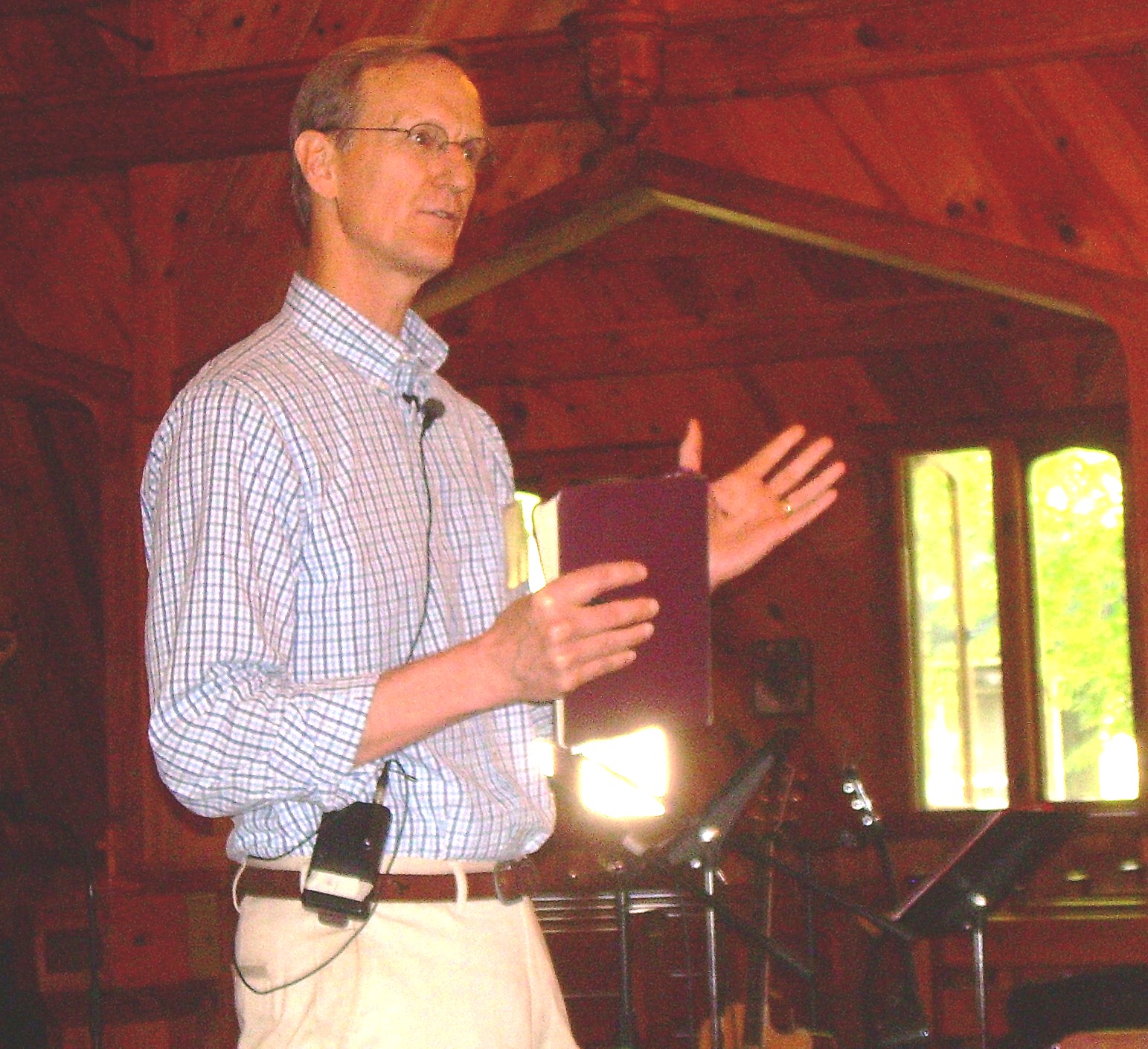
Do you believe God's Word has power to change lives today? This past weekend I spoke at the annual conference of Faith Alive, a lay witness ministry committed to spiritual renewal in the Episcopal Church. It was a wonderful opportunity to share my vision for church-based Bible reading revival. But the best thing about the weekend was not my messages. Rather, it was was the testimonies from Faith Alive leaders on the impact of reading the Bible.
One attendee shared that for the first half of his life he was afflicted with a debilitating stutter; it was so bad that he carefully planned his education, career and entire lifestyle around one anxious thought: I will never, ever be put in a position to speak in public. Then at age 24, as a Peace Corps volunteer in Africa, he attended a local church and to his shock was asked to read the Scripture passage out loud to the congregation.
The pastor, not knowing about the stutter, pressured him to read. As he stood in front of the church, he braced himself for yet another embarrassing struggle with his stutter. But to his amazement, as he began reading Ezekiel 37 about the Valley of the Dry Bones, his stutter disappeared! He was able to read the whole chapter with perfect clarity...and the stutter never returned. Today, the former stutterer is a parish priest who regularly reads, speaks and preaches in public with great effectiveness.
This weekend reminded me that Bible reading revival is not "my" vision. Rather, it's a reality and a spiritual power that has been alive among God's people for a long, long time. Let's pray that God causes it to spread like wildfire in our day.
by Whitney T. Kuniholm
Respond to this Post
Email this Post
What It Is
| 2 commentsBible engagement is on the move! More Christian leaders are talking about it. And more Christian organizations are spending money on it. That's all good. But I've been thinking about what it is; does anyone have a definition of "Bible engagement" that the average Christian can understand and remember? Well guess what? I'm going to take a crack at it.
But before I do, let's consider "what it's not." Bible engagement is not something only clergy can do; it's for everyone. And it's not something for people with lots of Bible experience; it's for Bible newbies too. And it's not just for people who like to read thick, dusty books before the sun comes up; it's for people who are hungry for meaning all day long. OK...so what is it? Drum roll, please...
Bible engagement is"the process of taking in and living out God's Word for the purpose of knowing him better and experiencing him more."
You can remember that, right? Now let me break it down for you:
Taking in...which usually involves reading, but it can also involve hearing or watching or drawing or singing, or you name it. I just got a new iPad2 and I'm discovering there are lots of creative ways to take in the Bible's message (when I'm not goofing around with the other apps).
Living out...it doesn't do any good to be a Bible-know-it-all if it doesn't make a difference in your actions. That's called hypocrisy. Over the years I've discovered the most effective Bible study "method" is to do what it says. That's when I really understand what it means.
Knowing him better...theologians say the Bible is God's "self-revelation." No matter what Bible passage you read, always ask, "What does this teach me about God?" If you want to know God, read his Book.
Experiencing him more...the Bible is like God's personal journal; reading it connects us to his personality, his heart, and we begin to sense he is "with us." For real. That's when the Bible becomes life-changing.
So that's my shot at defining Bible engagement. But I'm not saying it's the only definition. How would you describe it? Add a comment to this blog post and let me know...what it is.
by Whitney T. Kuniholm
Respond to this Post
Email this Post
Narnia and the Bible Reading Secret
| 11 commentsHave you seen the new movie, The Voyage of the Dawn Treader? It’s based on the third book in The Chronicles of Narnia, by C.S. Lewis. I was thinking about Narnia recently when suddenly it hit me that a famous detail in the story contains the secret to making the Bible come alive today. Let me explain.
by Whitney T. Kuniholm
Respond to this Post
Email this Post
Bible Reading Revival in Albany
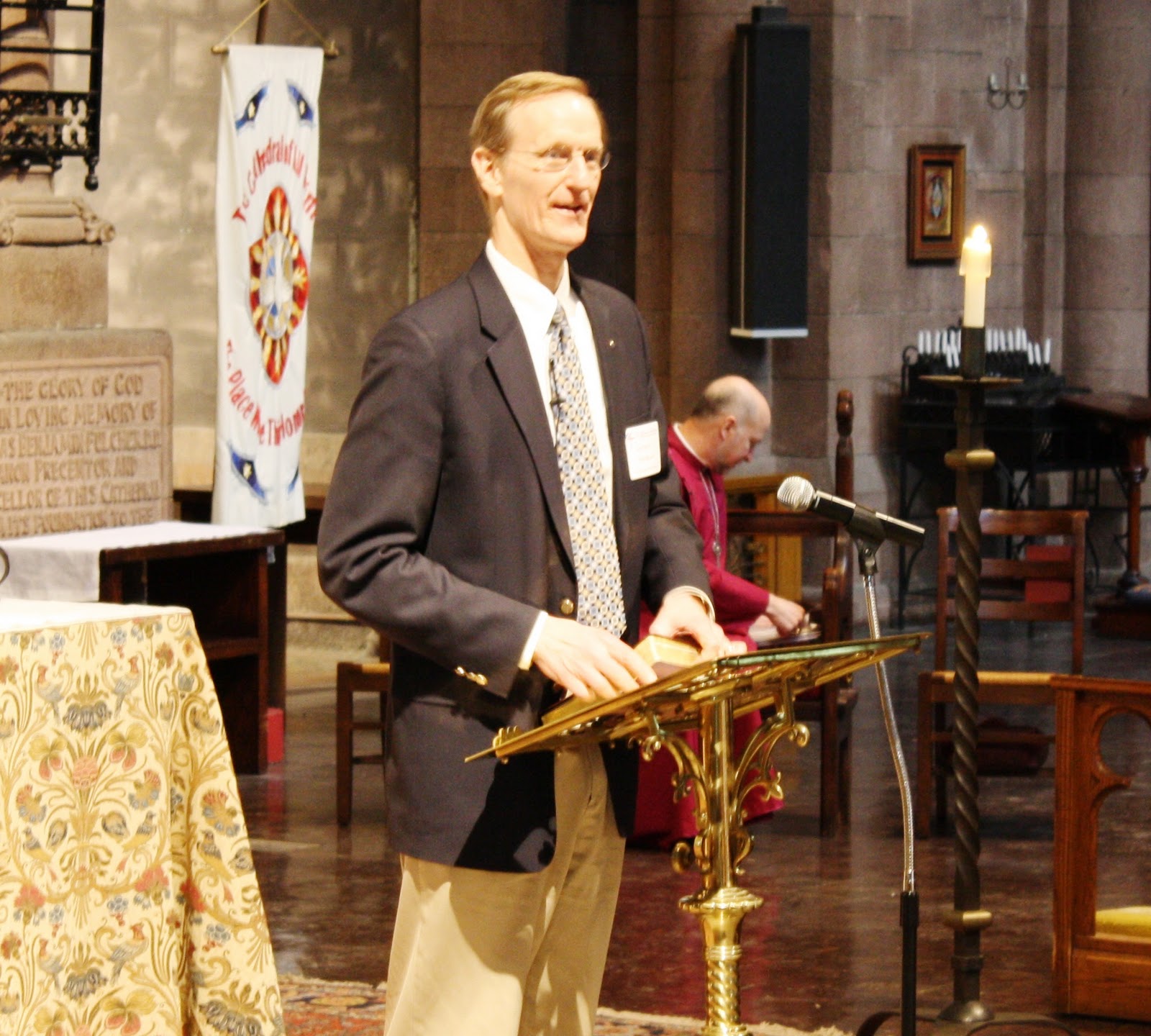
| 3 commentsMy messages covered themes I've pondered for years--examples of Bible reading revival in the Scriptures and Church history, a new approach to Bible reading, a bigger vision for Bible engagement, plus an effective church-wide Bible reading program called The Essential 100 Challenge (E100).
But what amazed me this time is that God began stirring people to action. Bishop William Love took the lead by standing to say, "I'm committing to reading these Essential 100 passages myself and I'm inviting everyone in the Diocese to join me." After that, all 120 churches, reaching some 9,000 parishioners, agreed to take the Challenge with the Bishop.
In addition, people began thinking of creative ways to reach out with God's Word. A woman planned to start several E100 groups at the local university. A man felt convicted that his church didn't have pew Bibles so he made it his mission to find some. A parish priest convinced his Vestry to host a community barbecue where people could share their Bible reading testimonies.
A few weeks later, the Standing Committee in Albany passed a resolution which said, "The Standing Committee unanimously endorses and commends to the Diocese the E100 Bible reading plan by Scripture Union. The Standing Committee members commit themselves to complete the program and to encourage its use in their parishes."
I know it's just a beginning, but I believe God is igniting a Bible reading revival in Albany. Now I'm praying it spreads to other Dioceses in the Episcopal Church. And I pray it won't stop there. I pray it spreads like wildfire to the Baptists, Methodists, Presbyterians, Lutherans, Catholics and yes, to seekers and non-believers too. I pray that God ignites a nationwide Bible reading revival, and I invite you to join me.
by Whitney T. Kuniholm

Respond to this Post
Email this Post
Top 10 Bible Engagement Books
| 3 commentsIt's the New Year and I bet you're already sitting around wondering what to do, right? Well, no need to panic because I've got the perfect solution, a do-it-yourself Bible Engagement Course based on my top 10 Bible engagement books. I'm convinced that reading these books could literally transform your experience of the Bible in 2011. So...you ready for the list?
Hang on...one comment before we begin. Because some are new to the notion of Bible engagement, I've organized the 10 books into a logical progression; they start with foundational issues and move to transformational issues (but you can read them in any order you want). And now, without further adieu, here are my top 10 Bible engagement books:
OK, that's my top 10 list. What's on your top 10 list...what books would you add? Feel free to share them by posting a comment to this blog. Let's build a list of great Bible engagement books together. Thanks!
by Whitney T. Kuniholm
Respond to this Post
Email this Post
Good News About Bible Engagement
| 2 comments
In my last post I mentioned a recent survey by The Pew Forum where atheists/agnostics scored higher in Bible knowledge than Christians. Doh! But this time, I want to tell you how I discovered the most significant and surprising outcome of the survey.
It happened last week at the annual meeting of the Forum of Bible Agencies-North America, a group of Christian leaders that are in some way involved in "the Bible cause." You might expect such an event to be a real yawner, especially since the Bible is everywhere in North America already. What's to talk about?
Actually, quite a bit. We invited Alan Cooperman, the man behind the Pew Survey of Religious Knowledge, to walk us through some of the key findings--that religion is very important to Americans, or that educational attainment is the single leading predictor of higher religious knowledge, or that...I hate to break it to you...a lot of Christians don't know their Bibles very well. So how did we respond? Did we booo, argue or kick him out for sharing such bad news? Far from it. We thanked Mr. Cooperman for helping us better understand the urgent need for Bible engagement among church-goers.
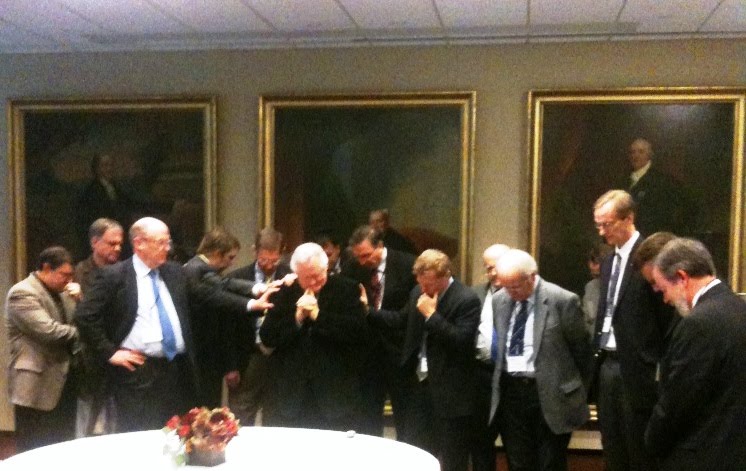
Then an unexpected thing happened; at the end, we joined together for an impromptu prayer meeting (see the picture above). We called out to God for Bible reading revival; we asked God to unify us so that we could help people of all ages read and live his Word. Standing in that circle of prayer made me realize God had used a negative secular survey to ignite a positive ministry outcome. That's significant. So I invite you to join the circle; join us in praying for Bible reading revival in your church, your community and your country.
by Whitney T. Kuniholm
Respond to this Post
Email this Post
A New Vision for "National Bible Week"
| 2 comments
Guess what? This is National Bible Week, the one time each year when US Christians unite to give three cheers for the Good Book. I'm all for that. There’s only one problem. It doesn't seem to be making much of a difference.
The most recent evidence came this fall when The Pew Forum on Religion and Public Life released the results of a major survey on religious knowledge in the United States. Among many questions about religion, participants were asked about their basic Bible knowledge. When all the data was tabulated, the findings were surprising:
- A higher percentage of Mormons could name all four Gospels than Evangelicals
- A majority of Protestants couldn’t identify who Job was
- Atheists and agnostics scored higher than Christians in overall Bible knowledge
First, let's start with a press conference to confess that the church has lost touch with its own Book. Second, let's all take a vow, that's right, an old fashioned vow (Psalm 116:14), not to buy another Bible until we've read through one we already have. Finally, let's announce a 10-year effort to get more church-goers reading the Bible. If we really want to ignite a Bible reading revival, that's what it'll take.
But does that mean we should forget about sharing God's Word with a needy world? Not at all! I'm convinced the best way to get non-believers into the Bible is not to post the 10 Commandments in the courthouse, or to fight for Bible reading in the public schools, or even to give out Bibles on the street corner. Rather, it's for believers to become passionate about reading and living God's Word themselves. When that happens, the church will have the spiritual credibility and power to say "come and join us." I can't wait for that kind of National Bible Week in 2011. How about you?
by Whitney T. Kuniholm
Respond to this Post
Email this Post
Archbishop Leads Bible Reading Campaign
| 0 commentsWant to see how one church leader is working for Bible reading revival? Anglican Archbishop Robert Duncan is promoting The Essential 100 Challenge (E100) throughout his entire Diocese of Pittsburgh, and he's hoping to expand the program nationally in the future. Check out this 3-minute video clip of his remarks (click the triangle in the photo below).
by Whitney T. Kuniholm
Respond to this Post
Email this Post
Devotional Lab Rats
| 0 comments
My friends at the Center for Bible Engagement (CBE) have researched how the Bible affects personal behavior. They call their key finding "scientific evidence for the power of 4." The bottom line is that reading or listening to the Bible four or more times per week leads to positive moral choices. More so than church attendance, or even prayer. That's significant. There’s only one problem: the research may tempt us to overlook the most important part of Bible engagement.
The CBE’s study isolates the frequency of a person’s engagement with the Bible; the goal, as stated in their conclusion, is “four scriptural touches a week.” But is frequency alone what makes the difference?
What if a study found "scientific evidence" that kissing one’s spouse four or more times per week produced a good marriage? I'd get right on it. Every Monday morning, first thing, I’d give Carol four pecks on the cheek, plus one extra for good measure. Bingo! I’d have a good marriage, right? I guarantee you, Carol wouldn't think so.
What makes kissing significant is not just “the number of touches.” It’s also the nature of those touches and the quality of the relationship behind them. That’s the perspective we need to hold in balance with the "4 or more" finding.
The CBE has done the church a great service in researching what faithful believers have known for centuries: regular Bible reading makes a big difference. But let’s be careful not to respond by reducing Bible engagement to frequency alone, otherwise we may increase the number of devotional lab rats in the church, but decrease the number who meet God every day in his Word. And ultimately, that's the most important goal.
by Whitney T. Kuniholm
Respond to this Post
Email this Post